
Sustainable Lending Instruments & Structuring
How sustainable debt is actually structured: green and social loans and bonds, sustainability-linked instruments, sovereign issuance, trade finance, KPI and SPT design, and the Singapore-Asia Taxonomy. Built for people who structure, originate, and review these deals.
The shift this microcredential makes
Knowing the instrument names
ToStructuring instruments that survive scrutiny from credit committees, investors, and regulators
Treating sustainability-linked as a growth market
ToUnderstanding why it contracted and what the market now requires for credibility
European-centric sustainable finance training
ToA Singapore-Asia Taxonomy module and Asian issuer cases built into the core curriculum
Framework lists without the hard questions
ToWhat to do when proceeds are misused, how to build a KPI audit trail, and how to manage structuring conflicts of interest
What you'll be able to do
- Explain the sustainable lending instrument landscape: green and social loans, green and social bonds, sustainability-linked loans and bonds, sovereign issuance, and trade finance
- Structure green and social loans against the four core components and the relevant loan and bond principles
- Run a green and social loan origination process, from data collection and creditworthiness through governance, credit decision, and monitoring
- Respond when proceeds are misused, using remediation protocols
- Design KPIs and sustainability performance targets that are material, measurable, and defensible, and validate the data behind them
- Apply sector-specific KPIs and benchmarks in power, real estate, and automotive
- Classify activities under the Singapore-Asia Taxonomy, including the judgment calls in transition and amber activities
- Assess the credibility of a borrower's transition plan
- Understand blended finance structures and manage conflicts of interest in structuring and review
Skills you'll gain
16 modules · 48 lessons · About 133 minutes
Explain the sustainable lending instrument landscape, understand the 2025 market shift away from sustainability-linked instruments toward use-of-proceeds and transition-labelled debt, and identify the new instruments introduced in late 2025.
Structure green and social loans against the four core components of the Green Loan Principles and Social Loan Principles.
Run a green and social loan origination process from data collection and ESG assessment through governance, credit decision, and ongoing monitoring.
Respond when proceeds are misused: identify trigger events, apply remediation protocols, and understand the credit and reputational consequences.
Structure green and social bonds under the ICMA Green Bond Principles and Social Bond Principles, and distinguish bond from loan obligations in documentation and disclosure.
Understand sovereign green bond programme design, with reference to Singapore's sovereign green bond framework and DBS and Bank of China issuance cases.
Design sustainability-linked loans with KPIs and SPTs that are material, measurable, and ambitious, and understand the pricing ratchet mechanism.
Build and validate the data infrastructure for SLL KPI monitoring, including evidence requirements, audit trails, and external verification.
Structure sustainability-linked bonds under the ICMA SLB Principles, and understand how the coupon step-up mechanism functions when targets are missed.
Apply sector-specific KPIs and benchmarks in power, real estate, and automotive using IEA and SBTi benchmarks and named issuer cases.
Understand how sustainability criteria integrate into trade finance products including supply chain finance, letters of credit, and guarantees.
Understand blended finance structures including first-loss tranches, concessional capital, and guarantees, and their role in mobilising private capital for sustainable projects.
Classify activities under the Singapore-Asia Taxonomy using its traffic-light system, including transition, amber, and watch-list activities such as hydrogen blending, CCUS, and sustainable aviation fuel.
Apply the judgment framework for amber and transition activities under the Singapore-Asia Taxonomy, using JSW Steel and Sembcorp as sector cases.
Assess the credibility of a borrower's transition plan against the criteria regulators and investors apply: ambition, coverage, capital allocation, governance, and accountability.
Identify and manage the structural conflicts of interest that arise when the same institution structures, prices, and reviews sustainability-linked transactions, and apply governance controls that protect both bank and borrower.
The credential you earn
A verified digital credential you can share publicly, and that stacks toward a full certification.
 Practitioner · Microcredential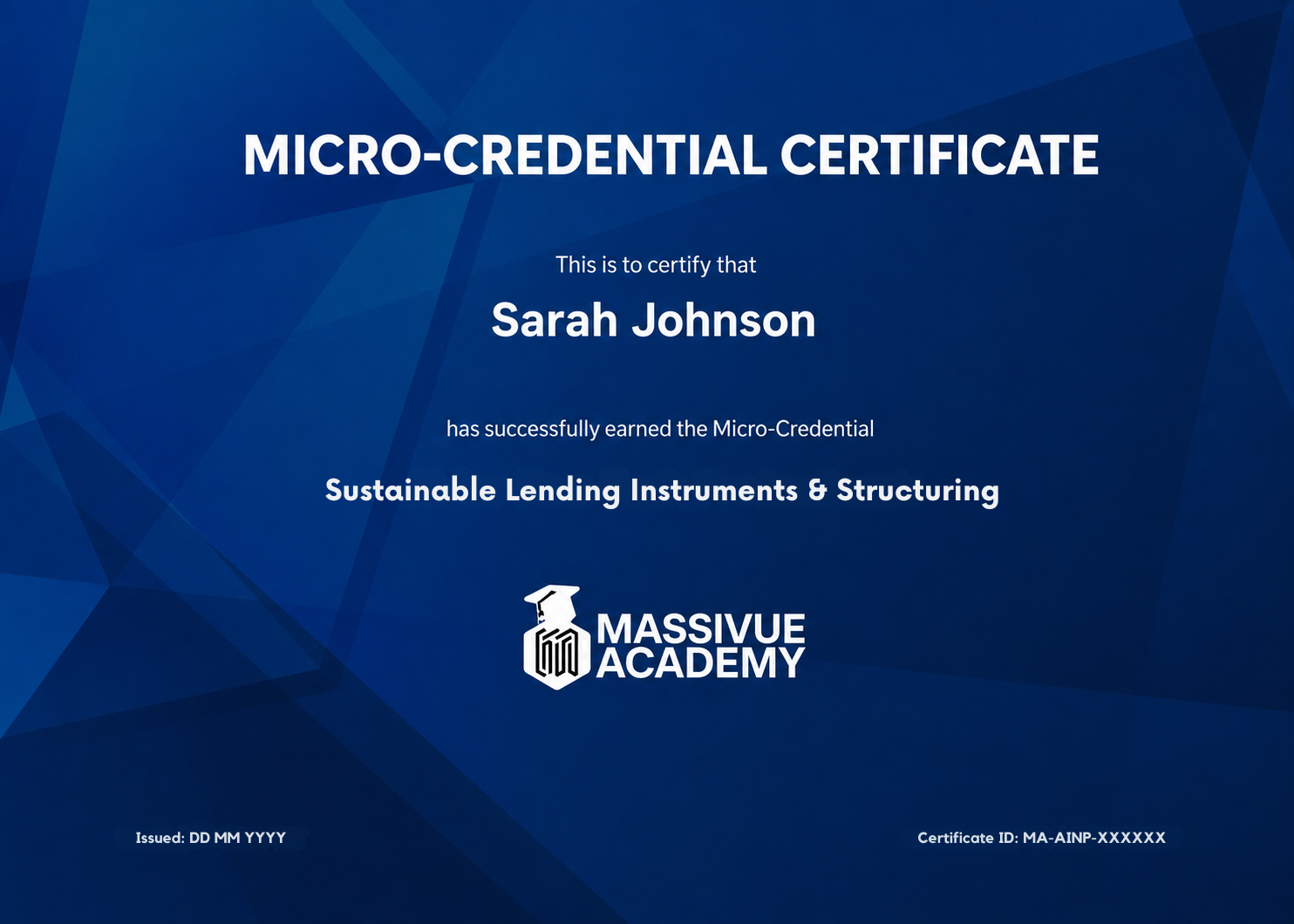
- Publicly verifiable via a unique credential link
- One-click add to your LinkedIn profile
- Verified digital credential, CPD recognition in progress
Complete both micro-credentials to earn Certified Sustainable Finance Specialist (Path B).
Self-paced microcredentials, about 3 hours 30 min of learning in total. Each one stands alone; together they earn the full certification.
Built for the people who structure the deal
Prerequisites: Working knowledge of lending or debt capital markets. This course does not teach credit fundamentals.
Everything in the credential
Bring this to your team
For teams
- Volume pricing and central billing
- Team progress reporting
- Optional tailored examples for your sector
Deliver under your brand
- Co-branded or fully white-label delivery
- Your LMS or ours
- Revenue-share partnership options
Questions, answered honestly
Both, and the distinction matters. Sustainability-linked instruments have contracted sharply under scrutiny over weak targets and thin disclosure. Use-of-proceeds instruments such as green loans have grown, and newly labelled transition instruments introduced in late 2025 are expected to expand. The market is consolidating around credibility, which raises the value of knowing how to structure these properly rather than how to badge them.
No. The principles are the starting point. The course spends its time on what the principles do not tell you: what to do when proceeds are misused, how to build an audit trail for KPI data, how to judge an amber transition activity, and how to manage the conflict of interest when the structurer also reviews the deal.
No, and that is deliberate. It includes a full module on the Singapore-Asia Taxonomy and uses Asian issuers and sovereign cases throughout. If you work in the region, most alternatives are written for a different regulatory reality.
It is a verified digital credential you can share and verify online. It is not an accredited professional designation or licence. CPD recognition is in progress.
Yes. This is the most technical course in the catalogue. It assumes you work in lending or debt capital markets and does not teach credit fundamentals.
Yes. Team access with volume pricing and central billing is available on request.
Related microcredentials
Start with one skill. Build toward a full certification.
Verified digital credential