
Sustainability Insurance & Re-Insurance
How sustainability is reshaping underwriting, claims, and capital in insurance and reinsurance: the frameworks, the metrics, ESG data you can defend, and the modelling of physical and transition risk. Built for people who work in the industry.
The shift this microcredential makes
Treating sustainability as a reporting exercise
ToSeeing how ESG factors reach underwriting, claims, pricing, and capital
Quoting frameworks by name
ToOperating them: controls, documentation, escalation, and defensible decisions
ESG data taken at face value
ToValidating, assuring, and auditing the data your decisions rest on
Physical and transition risk modelled separately
ToModelling the linkages, including litigation and liability risk
What you'll be able to do
- Explain the international and regional frameworks shaping sustainable insurance, including UN principles, regional regimes, and how the voluntary coalition landscape has shifted
- Apply sustainability metrics used in insurance, including underwriting emissions, carbon intensity, and fossil-fuel exposure, and align them to reporting standards
- Assess ESG data quality, and apply controls, assurance, and auditability so decisions are defensible
- Integrate ESG factors into underwriting decisions, with clear governance, escalation, and decision rights
- Communicate sustainability-linked underwriting requirements to clients and brokers
- Embed sustainability into reinsurance claims processes and claims supply chains
- Assess materiality of sustainability issues at sector and corporate level
- Understand methodologies for modelling physical and transition risk, including climate litigation and liability risk
Skills you'll gain
8 modules · 32 lessons · About 83 minutes
Explain the international and regional frameworks shaping sustainable insurance, including the UN Principles for Sustainable Insurance (PSI), regional regulatory regimes, and how the voluntary coalition landscape has shifted from the Net-Zero Insurance Alliance to the Forum for Insurance Transition to Net Zero (FIT).
Apply sustainability metrics used in insurance and reinsurance, including underwriting emissions, carbon intensity, and fossil-fuel exposure, and align them to reporting standards including TCFD and CSRD.
Assess ESG data quality and apply the controls, assurance methods, and audit frameworks that make sustainability decisions defensible to regulators, internal governance, and external stakeholders.
Integrate ESG factors into underwriting decisions with clear governance structures, decision rights, and escalation paths, drawing on sector-specific examples including agriculture, forestry, and hydropower.
Communicate sustainability-linked underwriting requirements to clients and brokers, explain exclusions and ESG criteria clearly, and manage the day-to-day friction points that arise in sustainability conversations.
Embed sustainability into reinsurance structures and claims processes, including sustainable claims supply chains, and understand how ESG factors flow from cedant to reinsurer.
Assess the materiality of sustainability issues at sector and corporate level, apply materiality governance frameworks, and connect materiality findings to underwriting, product, and portfolio decisions.
Understand methodologies for modelling physical and transition risk, including climate litigation and liability risk, and explore emerging concepts including nature-positive insurance and the role of technology in sustainability risk assessment.
The credential you earn
A verified digital credential you can share publicly, and that stacks toward a full certification.
 Practitioner · Microcredential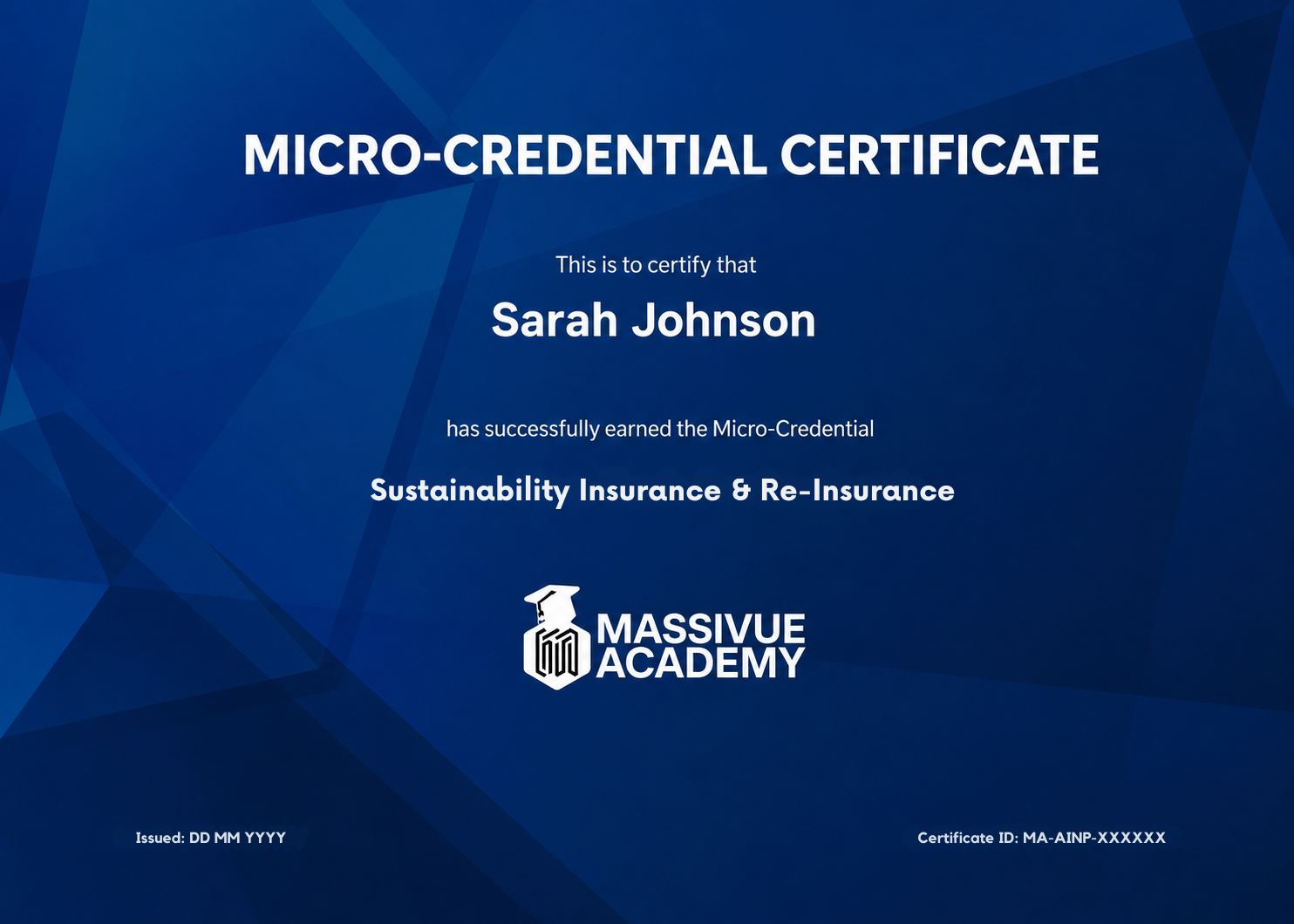
- Publicly verifiable via a unique credential link
- One-click add to your LinkedIn profile
- Verified digital credential, CPD recognition in progress
Complete all 4 to earn Certified Practitioner in Sustainability & Green Finance.
Self-paced microcredentials, about 5 hours 46 min of learning in total. Each one stands alone; together they earn the full certification.
Built for insurance and reinsurance professionals
Prerequisites: Working knowledge of insurance or reinsurance. This is the most specialised course in the portfolio and does not teach insurance basics.
Everything in the credential
Bring this to your team
For teams
- Volume pricing and central billing
- Team progress reporting
- Optional tailored examples for your sector
Deliver under your brand
- Co-branded or fully white-label delivery
- Your LMS or ours
- Revenue-share partnership options
Questions, answered honestly
It is a verified digital credential you can share and verify online. It is not an accredited professional designation or licence, and it should not be confused with one. CPD recognition is in progress.
It is a structured orientation, not a full programme. It gives you the frameworks, the metrics, the governance structures, and the data controls, and shows how they connect to underwriting, claims, and capital. It does not replace deep technical training or in-house policy.
The voluntary coalition landscape has been disrupted, most visibly when the Net-Zero Insurance Alliance disbanded in 2024 under antitrust and political pressure and was replaced by a broader UN-convened forum called FIT. But regulatory and supervisory expectations have continued to develop, and physical climate risk is still showing up in claims. The politics changed faster than the risk did.
No, but you should work in or with insurance. The course assumes industry vocabulary and does not teach insurance basics.
Lifetime access. Learn at your own pace and revisit anytime.
Yes. Team access with volume pricing and central billing is available on request.
Related microcredentials
Start with one skill. Build toward a full certification.
Verified digital credential