
AI-Powered Service Professionals (Financial Services)
Retrieve, Verify, Explain. Three steps that sit between the AI's confident output and the customer who will hold you to it.
What most courses get wrong, and what this one does differently
Tool training: here is the interface, here are the prompts, here is how to generate a reply faster
ToRetrieve, Verify, Explain: a three-step discipline that sits between the AI's confident output and the customer who will hold you to it
AI surfaces a recommendation, service staff relay it, nobody addresses whether they are authorised to
ToLead, Hold, Suppress framed as both a rapport skill and a licensing boundary: sometimes Suppress is not restraint, it is the law
Treating AI-drafted communications as ready to send
ToNaming honestly that AI-drafted follow-up is often impersonal and badly timed, and teaching the human edit that fixes it
No section on what must not be automated
ToModule 4, Topic 3: regulatory-grade complaints, FIDReC escalation, and an explicit list of what must never be delegated to AI
What you'll be able to do
- Explain what AI Assist can and cannot do, and where human judgement and accountability remain
- Apply MAS FEAT principles in day-to-day customer interactions
- Interpret AI-generated customer summaries, and identify the context the AI has missed
- Apply the Retrieve, Verify, Explain workflow, and never present an unverified AI output as fact
- Recognise common AI errors and know when to escalate rather than proceed
- Build rapport using the Acknowledge, Name, Prioritise framework
- Apply Lead, Hold, Suppress to manage AI-surfaced recommendations, and know when a recommendation must not be relayed at all
- Adapt communication style and use specific rather than generic empathy
- Handle PDPA, screen and verbal privacy, and third-party consent in live service situations
- Design post-sales follow-up journeys with a 30, 60, and 90 day cadence, and comprehension checks
- Decide what follow-up can be automated and what needs human review
- Respond appropriately to life events, including overriding automated communications when circumstances change
- Distinguish operational, relationship, and regulatory escalations
- Apply the LEARN and LAST service recovery frameworks, and close the recovery loop
- Recognise regulatory-grade complaints, FIDReC and MAS escalation considerations, and what must never be delegated to AI
- Rebuild customer confidence after failure, and feed service failures back into organisational learning
Skills you'll gain
4 modules · 20 lessons · About 80 minutes
Explain what AI Assist can and cannot do, apply MAS FEAT principles in service interactions, read AI-generated customer summaries critically, and apply Retrieve, Verify, Explain as the non-negotiable three-step workflow for every AI output
Build customer rapport using the Acknowledge, Name, Prioritise framework, adapt communication style, apply Lead, Hold, Suppress to AI-surfaced recommendations, and handle PDPA and consent in live service situations
Design post-sales follow-up journeys with comprehension checks, decide what to automate versus review, and respond appropriately to life events by overriding automated communications when the situation demands it
Distinguish escalation types, apply LEARN and LAST service recovery frameworks, recognise regulatory-grade complaints, understand FIDReC and MAS escalation, and identify what must never be delegated to AI
The credential you earn
A verified digital credential you can share publicly, and that stacks toward a full certification.
 Associate · Microcredential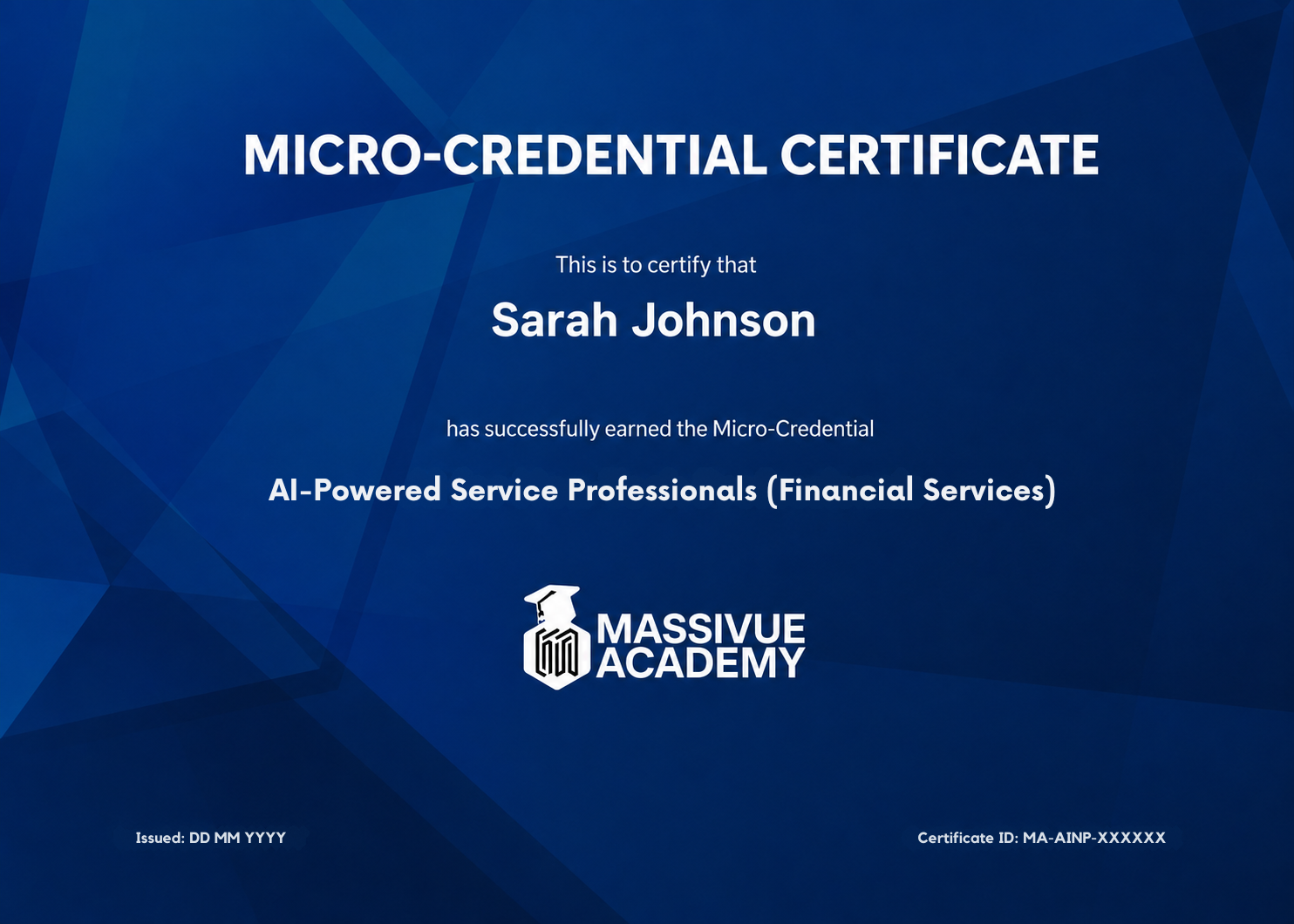
- Publicly verifiable via a unique credential link
- One-click add to your LinkedIn profile
- Verified digital credential, CPD recognition in progress
Complete both micro-credentials to earn Certified AI Finance Specialist.
Self-paced microcredentials, about 3 hours of learning in total. Each one stands alone; together they earn the full certification.
Built for the people the customer actually talks to
Prerequisites: Basic understanding of customer service principles and customer experience management. Basic digital literacy and ability to use workplace technology platforms. Familiarity with banking, financial services, or customer-facing business operations
Everything in the credential
Bring this to your team
For teams
- Volume pricing and central billing
- Team progress reporting
- Optional tailored examples for your sector
Deliver under your brand
- Co-branded or fully white-label delivery
- Your LMS or ours
- Revenue-share partnership options
Questions, answered honestly
It is already replacing parts of them. Retrieval, summarisation, and drafting are being automated, and that is not reversing. What is not being automated is empathy, judgement, accountability, and service recovery, which means the human role is concentrating into the hardest and highest-stakes moments. That is a harder job, not an easier one, and it requires more skill, not less.
Because you, not the AI, told the customer. The course's opening scenario is an AI that retrieves promotion information which turns out to conflict with the official terms. Repeat that to a customer and you have given them incorrect information about a financial product. Retrieve, Verify, Explain exists for exactly this.
Sometimes. Often you should hold them, and sometimes you must suppress them entirely. The AI surfaces opportunities without understanding context, and it does not know whether you are authorised to make a recommendation at all. Knowing the difference between service and advice is part of your job. It is not part of the AI's.
It is a verified digital credential you can share and verify online. It is not currently an accredited or government-recognised qualification. CPD recognition is in progress.
It is Singapore-anchored, referencing MAS FEAT, PDPA, and FIDReC. The frameworks and the AI verification discipline transfer anywhere, but the regulatory references are Singapore's.
Yes, and that is how it is meant to be used. AI Assist rollouts fail when different agents apply different standards of verification. A shared workflow is the point. Team access with volume pricing and central billing is available on request.
Related microcredentials
The easy work is being automated. The difficult work is becoming the whole job. This course is about the difficult work.
Verified digital credential