
AI-Powered Financial Advisory
Hyper-personalisation and persuasion are the same technology. Your guardrails and your objective function are what determine which one you have built.
What most courses get wrong, and what this one does differently
A productivity pitch: draft your client emails faster, prepare for meetings in half the time
ToBuilding the case for defensibility: grounded recommendations, source attribution, and a compliance officer who can read the syllabus without concern
Personalisation from a KYC form somebody filled in three years ago
ToA five-layer persona that updates on life-event triggers, making the AI an instrument of the client's actual current situation rather than their historical record
An AI that sounds like your firm, drawing on its own training data and the internet
ToAn AI that is your firm, grounded in approved product documents, house views, and compliance policies, with every output traceable to an approved source
Treating Module 4 governance as compliance bolted on at the end
ToNaming the personalisation-versus-persuasion tension explicitly: the same technology, pointed in two directions, and your guardrails are what determine which one you have built
What you'll be able to do
- Explain the advisory capacity gap and why segmentation no longer meets client expectations
- Distinguish LLMs, retrieval-augmented generation, agentic workflows, and traditional automation, and know which advisory task each suits
- Understand the anatomy of an AI advisory workflow across data, reasoning, guardrails, and channels, and recognise its common failure modes
- Apply MAS FEAT principles and PDPA considerations to advisory AI
- Build dynamic, five-layer client personas spanning demographics, goals, behavioural signals, risk personality, and life context
- Move from static KYC profiles to living personas that update on life-event triggers
- Design advisory prompts using system prompts, persona prompts, few-shot examples, structured outputs, and negative instructions
- Explain why AI hallucinates and why ungrounded AI creates suitability risk
- Implement retrieval-augmented generation over a trusted, governed knowledge base of approved firm content
- Apply source attribution and explainability so any recommendation can be traced to an approved source, and know when not to use RAG
- Design guardrails: scope limitations, mandatory disclaimers, escalation triggers, human review checkpoints, and audit logging
- Run bias and adversarial testing, and monitor advisory AI in production
- Take AI advisory services from pilot to production with a governance operating model
Skills you'll gain
4 modules · 20 lessons · About 80 minutes
Explain the advisory capacity gap, distinguish the AI tooling options and their appropriate uses, understand the anatomy of an AI advisory workflow, and apply MAS FEAT principles and PDPA to advisory AI
Build five-layer client personas, move from static KYC to living personas updated by life-event triggers, and design advisory prompts that produce genuinely personalised, structured, and compliant output
Explain why ungrounded AI creates suitability risk, build a trusted firm knowledge base, implement RAG over approved content, apply source attribution and explainability, and know when not to use RAG
Design guardrails and human-in-the-loop patterns for advisory AI, run bias and adversarial testing, monitor AI in production, and take an advisory AI service from pilot to production with a governance operating model
The credential you earn
A verified digital credential you can share publicly, and that stacks toward a full certification.
 Practitioner · Microcredential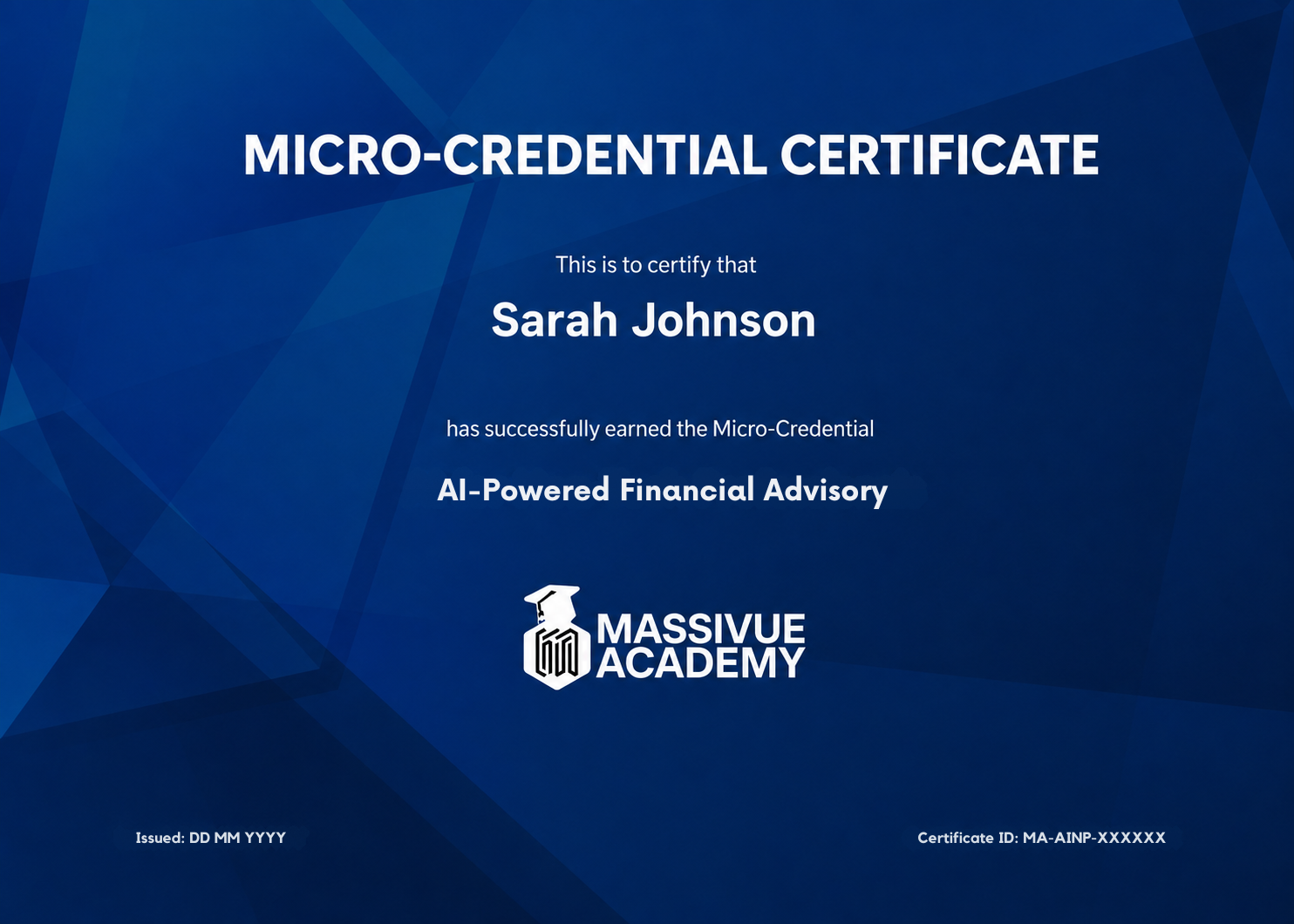
- Publicly verifiable via a unique credential link
- One-click add to your LinkedIn profile
- Verified digital credential, CPD recognition in progress
Complete both micro-credentials to earn Certified AI Finance Specialist.
Self-paced microcredentials, about 3 hours of learning in total. Each one stands alone; together they earn the full certification.
Built for the people who sign the recommendation
Everything in the credential
Bring this to your team
For teams
- Volume pricing and central billing
- Team progress reporting
- Optional tailored examples for your sector
Deliver under your brand
- Co-branded or fully white-label delivery
- Your LMS or ours
- Revenue-share partnership options
Questions, answered honestly
No, and this is the assumption most likely to get a firm into trouble. Across the major regimes there is no lighter rulebook for automated or AI-assisted advice. The same suitability and investor-protection obligations apply, and regulators add scrutiny of how the algorithm was designed, monitored, and explained. AI does not reduce your obligations; it adds a layer of them.
The AI does not make advice suitable or unsuitable; the adviser does. What AI can do is make an unsuitable recommendation look extremely persuasive, extremely quickly, at scale. Which is exactly why grounding, attribution, guardrails, and human review are not optional features of an advisory AI. They are the product.
That is the risk, and it is worth saying out loud. The same persona model that lets you tailor advice to a client's goals and risk personality would also let you tailor persuasion to their psychological triggers. The technology cannot tell the difference. Your objective function and your guardrails can. This course is explicit about that boundary.
You show them. That is what grounding and source attribution are for, and it is the single most important capability in the course. If you cannot trace a recommendation back to approved firm knowledge, you should not be sending it.
It is Singapore-anchored, built around MAS FEAT and PDPA. If you operate under MAS, it is directly applicable, and you should also be reading MAS's Guidelines on the Provision of Digital Advisory Services. If you operate elsewhere, the architecture and controls transfer, but map them to your own regulator's suitability and algorithm-governance expectations.
It is a verified digital credential you can share and verify online. It is not an accredited or government-recognised qualification, and it is not regulatory, legal, or investment advice. CPD recognition is in progress.
Yes, and they should. The entire course is about a boundary that advisers and compliance have to agree before anything is deployed. Team access with volume pricing and central billing is available on request.
Related microcredentials
If you cannot trace a recommendation back to approved firm knowledge, you should not be sending it.
Verified digital credential