
AI-Powered Banking Operations
Agent Supports, Analyst Decides. This course teaches you to design that boundary so it survives a supervisory review.
What most courses get wrong, and what this one does differently
A vendor demo with compliance bolted on at the end, showing what the tool can do and leaving you to work out what you are allowed to do
ToDesigning the agent's job description before the agent: scope, inputs, outputs, escalation triggers, and named human owner
A chatbot and a prompt, with no architecture and nothing a regulator can inspect
ToA four-layer architecture (data, reasoning, guardrails, channel) with an audit trail, and an AI grounded in your own typology libraries rather than the internet
Treating the SAR narrative as the AI's output and the analyst as the reviewer
ToThe Author Rule: the analyst is the author, accountable for the investigative judgement, the narrative, and the filing decision
What you'll be able to do
- Diagnose where AI creates real leverage in KYC onboarding and AML operations, and where it does not
- Distinguish rule-based automation, generative AI copilots, and agentic workflows, and select the right operating model for each task
- Apply the regulatory foundations governing AI-assisted regulated decisions, including MAS Notice 626 and FATF expectations
- Design human accountability into AI workflows using the Agent Supports, Analyst Decides principle
- Recognise how poor input data produces confident, polished, wrong output, and control for it
- Identify high-value KYC use cases: document extraction, beneficial ownership mapping, adverse media synthesis, source of wealth, and CDD memo drafting
- Architect an agentic KYC workflow across data, reasoning, guardrails, and channel layers, with an audit trail a regulator can inspect
- Define an agent's scope, inputs, outputs, escalation triggers, and named human owner
- Apply context engineering to ground AI in the bank's own policies, risk appetite, and PEP and sanctions logic
- Use AI to triage transaction monitoring alerts and assemble investigation packages
- Ground an AML assistant in firm-specific typology libraries using retrieval-augmented generation
- Draft SAR narratives with correct source attribution and citation integrity, under the Author Rule
- Apply FEAT principles and MAS Technology Risk Management expectations to operational AI
- Choose human-in-the-loop patterns: copilot, recommendation-plus-review, and routing
- Run adversarial testing for hallucination, prompt injection, fairness, and data leakage before deployment
Skills you'll gain
4 modules · 20 lessons · About 80 minutes
Diagnose where AI creates real leverage in KYC and AML, distinguish automation from agentic workflows, apply the regulatory foundations, and design human accountability using the Agent Supports, Analyst Decides principle
Identify high-value KYC use cases, architect an agentic KYC workflow across all four layers, define the agent's scope and escalation design, and apply context engineering to ground AI in the bank's own knowledge
Use AI for alert triage and investigation package assembly, ground an AML assistant in firm-specific typology libraries using RAG, and draft SAR narratives under the Author Rule with correct source attribution
Apply FEAT principles and MAS Technology Risk Management to operational AI, choose human-in-the-loop design patterns, and run adversarial testing for hallucination, prompt injection, fairness, and data leakage before deployment
The credential you earn
A verified digital credential you can share publicly, and that stacks toward a full certification.
 Practitioner · Microcredential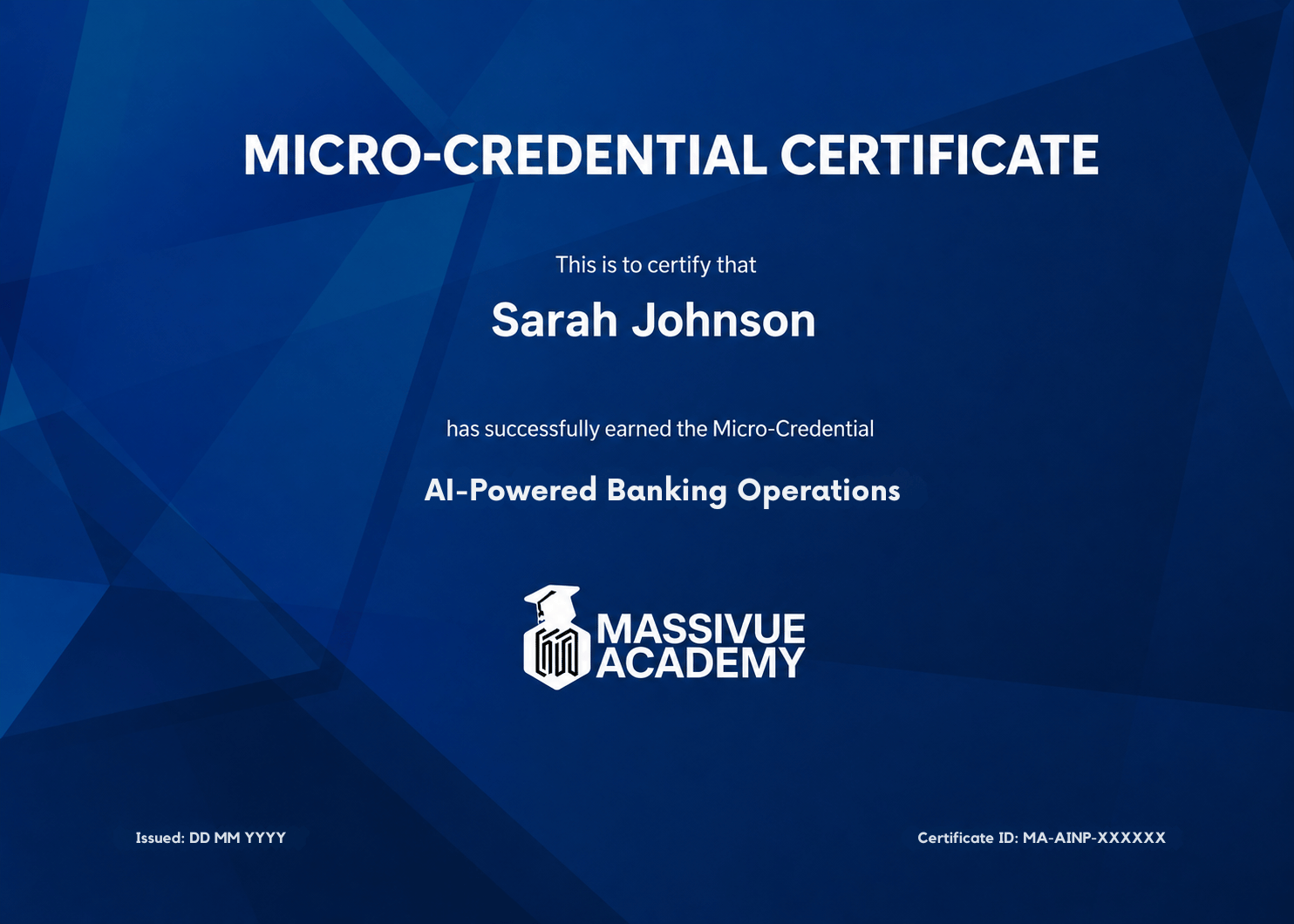
- Publicly verifiable via a unique credential link
- One-click add to your LinkedIn profile
- Verified digital credential, CPD recognition in progress
Complete both micro-credentials to earn Certified AI Banking Specialist.
Self-paced microcredentials, about 3 hours of learning in total. Each one stands alone; together they earn the full certification.
Built for the people who own the regulated decision
Prerequisites: Basic understanding of banking operations, financial crime compliance, or risk management processes. Basic digital literacy and familiarity with operational workflows
Everything in the credential
Bring this to your team
For teams
- Volume pricing and central billing
- Team progress reporting
- Optional tailored examples for your sector
Deliver under your brand
- Co-branded or fully white-label delivery
- Your LMS or ours
- Revenue-share partnership options
Questions, answered honestly
The regulated decision is not the AI's to make, and that is the point. AI can assemble evidence, extract documents, synthesise adverse media, and draft narratives. The onboarding decision, the escalation decision, and the filing decision stay with a named human owner. This course teaches that boundary as a design principle, not a disclaimer.
It makes them more convincingly. That is the real risk, and it is why Garbage In, Polished Out is one of the first things this course teaches. Generative AI produces fluent, well-formatted output regardless of whether the input was complete. Every control in the course exists to interrupt that.
It will not eliminate them. What AI can do is compress the triage work: assembling the alert context, pulling counterparty information, surfacing relevant typologies, and drafting a summary, so the analyst spends their time on judgement rather than assembly. The rigour stays. The clerical load drops.
It is Singapore-anchored, using MAS Notice 626, MAS Technology Risk Management Guidelines, and the FEAT principles, alongside FATF recommendations which apply globally. If you operate under MAS, it is directly applicable. If you do not, the architecture, the accountability design, and the testing regime transfer, but you should map them to your own regulator's expectations.
It is a verified digital credential you can share and verify online. It is not an accredited or government-recognised qualification, and it is not regulatory or legal advice. CPD recognition is in progress.
Yes, and that is the right way to use it. The whole course is about the boundary between what the agent does and what the analyst owns, and that boundary has to be agreed by operations, compliance, and technology together. Team access with volume pricing and central billing is available on request.
Related microcredentials
The Author Rule: AI may draft the SAR narrative. The analyst is the author, accountable for the investigative judgement, the narrative, and the filing decision.
Verified digital credential