
AI Change Management: Upskilling & Reskilling
You will decide who gets developed, who gets redeployed, and who gets let go. This course is about making those decisions well.
What most courses get wrong, and what this one does differently
A slide deck about embracing the future and a link to a learning platform, treating resistance as a communication problem
ToStarting with segmentation: the AI fluency spectrum and the role risk matrix, then asking which roles to upskill, reskill, or transition
Treating all resistance as an attitude problem to be overcome
ToDiagnosing rational, emotional, and structural resistance separately, because rational resistance is often correct and the most useful signal you have
Treating reskilling as an unambiguously positive story
ToNaming the tension honestly: 85 percent of employers plan to upskill and 40 percent plan to cut, and the decisions are being made right now
What you'll be able to do
- Assess how AI is reshaping roles and tasks in your organisation, and distinguish automation from augmentation
- Identify which skills are declining, which endure, and where human capability remains decisive
- Segment your workforce across an AI fluency spectrum, from aware to expert
- Build a role risk matrix weighing automation risk against transferability, and make defensible upskill, reskill, or transition decisions
- Design an AI skills taxonomy that holds across functions
- Run a skills gap analysis and prioritise investment by business impact and urgency
- Design tiered, role-specific upskilling pathways and choose a learning platform strategy
- Apply change management models (ADKAR, Kotter, Bridges) to AI transformation
- Diagnose rational, emotional, and structural resistance, and respond to each appropriately
- Build a communication strategy and an AI champions network that drives peer-led adoption
- Design reskilling programmes for at-risk roles, with career support and psychological safety
- Measure ROI and link learning investment to business outcomes
Skills you'll gain
4 modules · 20 lessons · About 80 minutes
Assess how AI is reshaping roles, segment the workforce across an AI fluency spectrum, build a role risk matrix, and make defensible upskill, reskill, or transition decisions
Design an AI skills taxonomy that holds across functions, run a gap analysis, prioritise investment by business impact, and design tiered upskilling pathways with a platform strategy
Apply ADKAR, Kotter, and Bridges to AI transformation, diagnose rational, emotional, and structural resistance, build a change communication strategy, and establish an AI champions network
Design reskilling programmes for at-risk roles with psychological safety and ethical transition support, and measure learning ROI linked to business outcomes
The credential you earn
A verified digital credential you can share publicly, and that stacks toward a full certification.
 Associate · Microcredential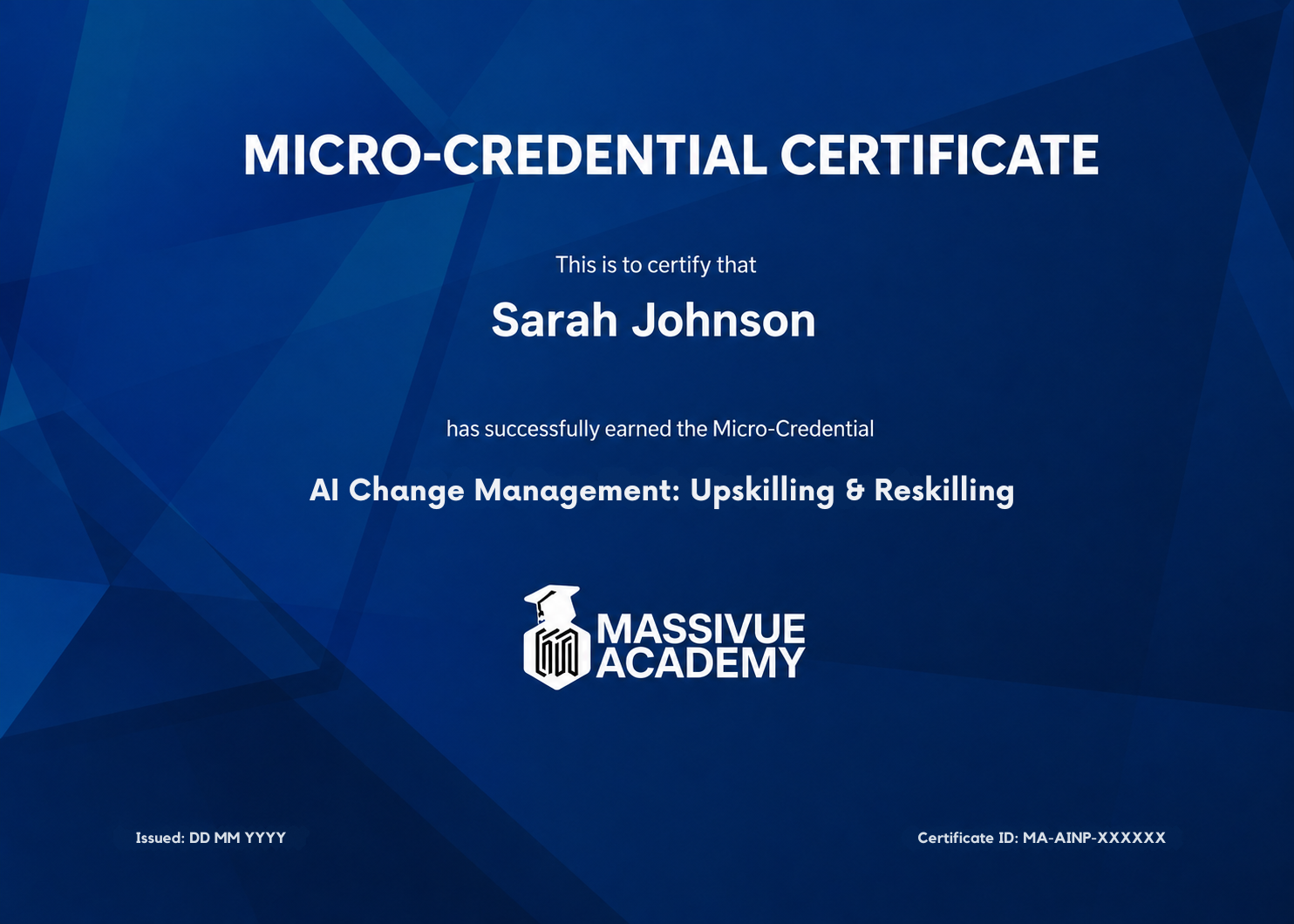
- Publicly verifiable via a unique credential link
- One-click add to your LinkedIn profile
- Verified digital credential, CPD recognition in progress
Complete all 5 to earn Certified Associate in AI and Digital Transformation.
Self-paced microcredentials, about 5 hours 30 min of learning in total. Each one stands alone; together they earn the full certification.
Built for the people who have to bring everyone with them
Prerequisites: Experience in HR, L&D, talent, transformation, or business leadership roles. Involvement in workforce planning, capability building, or change initiatives. Basic awareness of AI’s impact on jobs and productivity (no technical AI skills needed). Designed for managers and decision-makers, not developers
Everything in the credential
Bring this to your team
For teams
- Volume pricing and central billing
- Team progress reporting
- Optional tailored examples for your sector
Deliver under your brand
- Co-branded or fully white-label delivery
- Your LMS or ours
- Revenue-share partnership options
Questions, answered honestly
Sometimes, and pretending otherwise would be dishonest. In the WEF's 2025 survey, 85 percent of employers said they would prioritise upskilling and 40 percent said they would reduce staff whose skills became less relevant. Those are the same employers. This course does not claim reskilling saves everyone. It teaches you how to decide who to develop, who to redeploy, and how to handle the cases it does not cover, with the ethics and the support that requires.
There is some real evidence. Skills instability has fallen from 57 percent in 2020 to 44 percent in 2023 to 39 percent now, and the WEF attributes part of that to reskilling investment, with half the workforce having now completed training, up from 41 percent. It is not a cure-all, but it is not theatre either.
That is usually where the failure starts. Content is abundant and cheap. The hard part is knowing who needs what, why now, and what happens to the people your answer does not cover. Organisations that struggle with reskilling are typically not failing at learning delivery; they are failing at diagnosis, working from job titles rather than actual skills.
It can help you tell the difference between kinds of resistance, which matters more than overcoming it. Rational resistance is often correct. When an employee says a tool will make their job worse, that may be accurate feedback about a badly designed rollout, not an attitude problem. Programmes that treat all resistance as a communication failure destroy the most useful signal they have.
No. This is a change leadership course. You need to lead people, not build models.
It is a verified digital credential you can share and verify online. It is not an accredited or government-recognised qualification. CPD recognition is in progress.
Yes, and it is designed for that. Workforce transformation fails when leaders hold different mental models of what is happening. Team access with volume pricing and central billing is available on request.
Related microcredentials
Content is abundant and cheap. Knowing who needs what, why now, and what happens to the people your answer does not cover is the actual job.
Verified digital credential