
Digital Strategy for AI Business Success
Model access is table stakes, not strategy. This course is about building the thing they cannot buy.
What most courses get wrong, and what this one does differently
An adoption programme in a strategy costume: AI is important, here are use cases, go run pilots
ToForcing a positioning choice: where on the spectrum from AI-enabled to AI-native do you intend to compete, and what trade-off does that require
Treating model access, prompt libraries, and early chatbot deployment as competitive advantage
ToGoing straight at defensibility: the moat question that separates strategy from spend
Treating operating model design as an org-chart detail for HR to sort out later
ToMaking the CoE, federated, or hybrid decision deliberately, because it determines whether AI capability compounds or gets stranded
What you'll be able to do
- Explain why AI is a strategic inflection point, and diagnose the common AI strategy failure modes
- Position your organisation on the AI strategy spectrum, from AI-enabled to AI-native, and accept the trade-offs that follow
- Apply structured strategy frameworks to AI, including competitive-forces analysis and an AI strategy canvas
- Assess AI maturity honestly and align ambition with capability across investment horizons
- Choose between AI business model archetypes: AI-as-a-service, AI-enhanced products, AI-native platforms, and outcome-based models
- Redesign the value chain around AI and identify where monetisation is genuinely possible
- Identify and build a defensible AI moat: data flywheel, network effects, switching costs, and ecosystem lock-in
- Model competitive scenarios and plan strategic responses under different futures
- Design an AI operating model, and choose between Centre of Excellence, federated, and hybrid structures
- Treat data as a competitive asset, and build the governance and quality to make that true
- Make platform, ecosystem, and build-buy-integrate decisions deliberately
- Allocate capital across an AI portfolio and link investment to strategy
- Establish board-level AI governance and measure strategic impact with an AI scorecard
Skills you'll gain
4 modules · 20 lessons · About 80 minutes
Explain why AI is a strategic inflection point, position your organisation on the AI strategy spectrum, apply an AI strategy canvas and competitive-forces analysis, and assess maturity against ambition across investment horizons
Choose between AI business model archetypes, redesign the value chain for AI monetisation, and build a defensible competitive moat using data flywheels, network effects, switching costs, and ecosystem lock-in
Design an AI operating model and choose between CoE, federated, and hybrid structures; treat data as a strategic asset; set platform and ecosystem strategy; and make build-buy-integrate decisions deliberately
Allocate capital across an AI portfolio by horizon, establish board-level AI governance, measure strategic AI impact with a scorecard, and manage the transition from pilots to enterprise scale
The credential you earn
A verified digital credential you can share publicly, and that stacks toward a full certification.
 Associate · Microcredential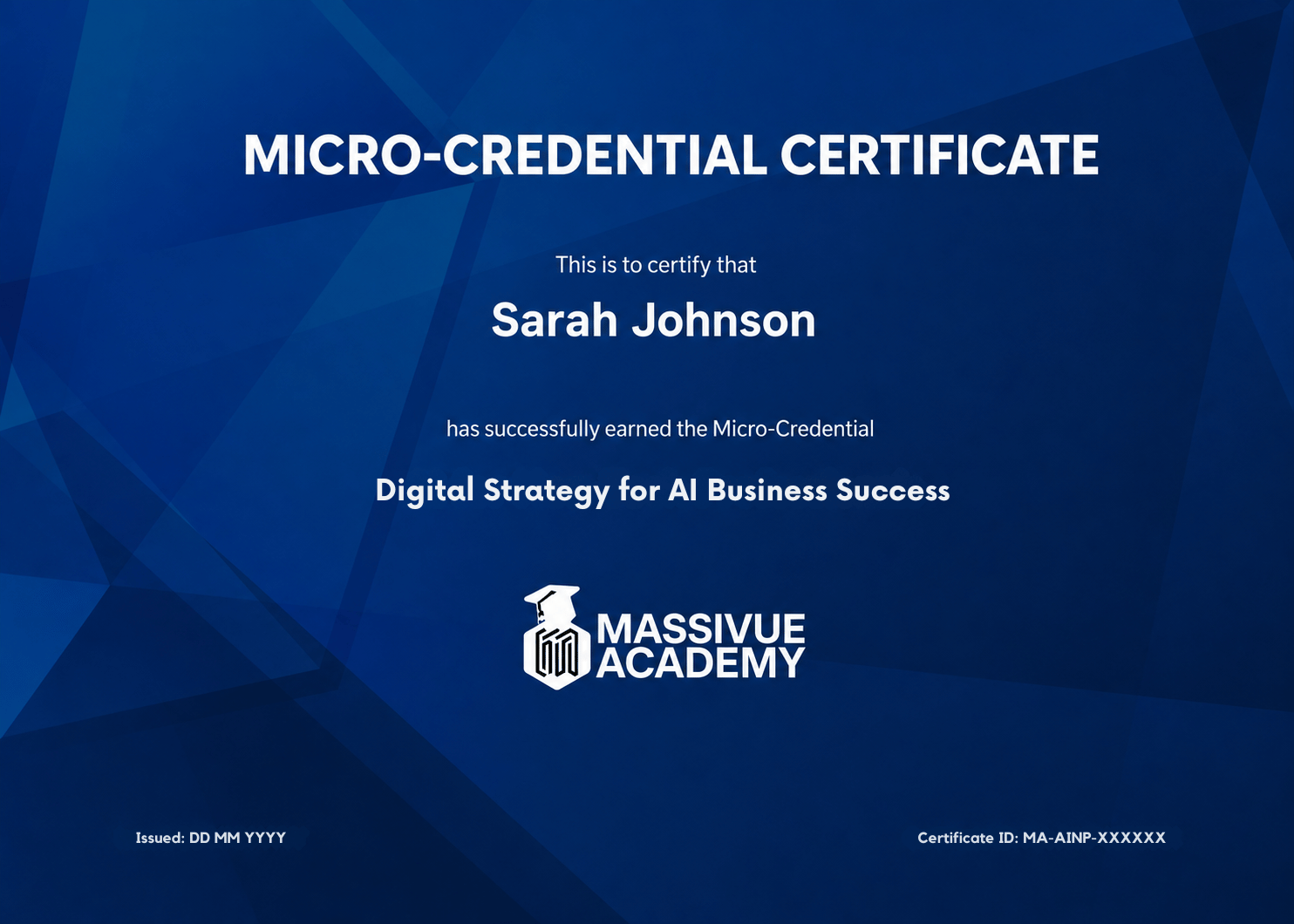
- Publicly verifiable via a unique credential link
- One-click add to your LinkedIn profile
- Verified digital credential, CPD recognition in progress
Complete all 4 to earn Certified Enterprise Leader in AI & Digital Transformation.
Self-paced microcredentials, about 4 hours 10 min of learning in total. Each one stands alone; together they earn the full certification.
Built for the people who decide where to compete
Prerequisites: Leadership, strategy, or decision-making responsibility within a business or function. Involvement in digital, growth, innovation, or transformation initiatives. Interest in using AI for competitive advantage rather than technical implementation. No coding, data science, or AI engineering background required
Everything in the credential
Bring this to your team
For teams
- Volume pricing and central billing
- Team progress reporting
- Optional tailored examples for your sector
Deliver under your brand
- Co-branded or fully white-label delivery
- Your LMS or ours
- Revenue-share partnership options
Questions, answered honestly
Yes, but not where most people look for it. Model access is now table stakes: your competitors can license the same models and match your implementation within weeks. Durable advantage comes from what surrounds the model: proprietary data that compounds with use, workflow integration deep enough that removal would break the business, distribution you already own, trust in high-stakes contexts, and network effects. That list is the course.
No, and confusing the two is the most expensive mistake in enterprise AI. Adoption stops you falling behind. Strategy is a decision about where you will be defensibly different, which is a business model, data, and operating model question, not a technology one.
Briefly, and not durably. Everyone gets the upgrade. First-mover advantage is real when you are first to rebuild a core process around AI in a way that uses assets nobody else has. It is not real when you are first to deploy a chatbot.
This one is about competitive positioning and defensibility: business models, moats, and operating model. Our Economics of AI Investment course is about quantifying value, and our AI Change Management course is about getting people to adopt it. Different questions, different courses, and most organisations need all three in that order.
It is a verified digital credential you can share and verify online. It is not an accredited or government-recognised qualification. CPD recognition is in progress.
Yes, and strategy courses are worth very little taken alone. The value is a leadership team that shares one honest view of where the organisation actually has an advantage. Team access with volume pricing and central billing is available on request.
Related microcredentials
If a strategy document could be written by the vendor, it is not a strategy. This course is about what only you can build.
Verified digital credential