
ESG Risk Professional
How ESG risk is actually identified, assessed, and managed inside an enterprise risk framework: double materiality, climate scenario analysis, human rights due diligence, greenwashing exposure, GHG accounting, and ESG data you can defend.
The shift this microcredential makes
ESG as a reporting and communications exercise
ToESG risk as an operational discipline with financial consequences
Describing climate risk
ToRunning scenario analysis that quantifies forward-looking exposures
Sustainability claims written for marketing
ToESG communications built as a defensible, auditable position
ESG as separate from risk management
ToESG exposures integrated into the enterprise risk framework with clear ownership
What you'll be able to do
- Explain the ESG risk landscape and how ESG risks translate into business and financial impact
- Assess risks across the environmental, social, and governance pillars, including human rights due diligence
- Apply double materiality to distinguish financial materiality from impact materiality
- Use ESG risk frameworks, risk matrices, and prioritisation methods
- Integrate ESG risk into enterprise risk management, including climate scenario analysis and risk ownership
- Turn ESG risks into strategic opportunities through circular models and sustainable innovation
- Map and engage stakeholders, and manage greenwashing and ESG claim-integrity risk
- Understand GHG accounting across Scope 1, 2, and 3, and govern ESG data quality
- Build an ESG action plan and connect ESG risk to financial and capital allocation decisions
Skills you'll gain
9 modules · 31 lessons · About 113 minutes
Explain how ESG risks translate into business and financial impact, distinguish ESG risk from ESG reporting, and apply the opening scenario to map exposures across a real enterprise.
Assess risks across all three ESG pillars, apply human rights due diligence as a structured process of identification, escalation, and remediation, and understand governance risk at board and operational level.
Apply double materiality to distinguish financial materiality (ESG risks that affect the company) from impact materiality (the company's effects on the world), and understand why single-lens approaches produce incomplete risk assessments.
Integrate climate risk into enterprise risk management using scenario analysis, understand the Paris Agreement and net-zero pathways as a risk reference point, and quantify forward-looking exposures rather than just describing them.
Apply ESG risk frameworks, build and use risk matrices, and prioritise exposures using likelihood, severity, and velocity to produce an output defensible to risk owners, boards, and auditors.
Identify and manage greenwashing and ESG claim-integrity risk as a liability surface, understand the regulatory and litigation landscape, and apply controls that make sustainability communications defensible.
Understand GHG accounting across Scope 1, 2, and 3, and apply the data governance and quality controls that make ESG data defensible to auditors, regulators, and investors.
Integrate ESG risk into enterprise risk management processes, apply change management principles to embed ESG accountability, and connect ESG risk to circular models and sustainable innovation opportunity.
Connect ESG risk assessment to financial and capital allocation decisions, understand ESG integration in credit, investment, and M&A analysis, and build an ESG action plan with measurable risk-reduction milestones.
The credential you earn
A verified digital credential you can share publicly, and that stacks toward a full certification.
 Professional · Microcredential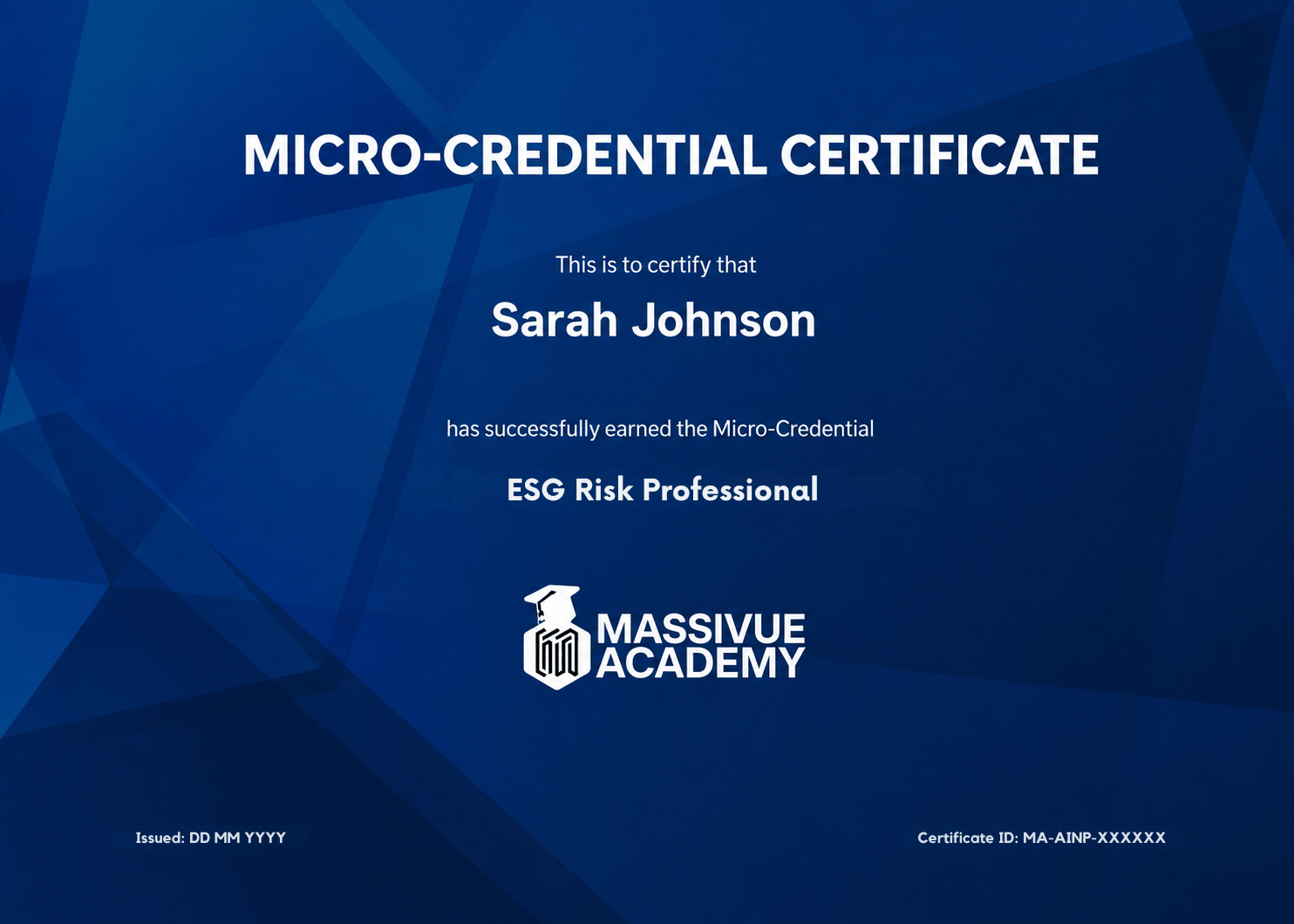
- Publicly verifiable via a unique credential link
- One-click add to your LinkedIn profile
- Verified digital credential, CPD recognition in progress
Complete both micro-credentials to earn Certified ESG Risk Specialist (Path A).
Self-paced microcredentials, about 3 hours 15 min of learning in total. Each one stands alone; together they earn the full certification.
Built for people who own the exposure
Prerequisites: Some professional or business experience. No technical or finance background required.
Everything in the credential
Bring this to your team
For teams
- Volume pricing and central billing
- Team progress reporting
- Optional tailored examples for your sector
Deliver under your brand
- Co-branded or fully white-label delivery
- Your LMS or ours
- Revenue-share partnership options
Questions, answered honestly
No, and it does not pretend to be. The SCR is an exam-assessed, globally recognised credential requiring around 100 hours of preparation. This is a focused microcredential covering the operational practice of ESG risk. If your goal is the recognised designation, take the SCR. If your goal is to do the work competently, start here.
The communication has retreated; the exposure has not. Regulators are pursuing misleading environmental claims, disclosure regimes are demanding auditable data, and human rights due diligence is becoming mandatory in more jurisdictions. Companies talking about ESG less have not become less exposed to it.
Fundamentals is the foundation: what ESG is, the pillars, the frameworks. This is the risk specialisation: how exposures are identified, scored, owned, integrated into enterprise risk management, and defended with evidence.
It is a verified digital credential you can share and verify online. It is not an accredited or government-recognised qualification. CPD recognition is in progress.
No, but the course assumes professional context. It is written for people who will be responsible for an exposure, not just describing one.
Yes. Team access with volume pricing and central billing is available on request.
Related microcredentials
Start with one skill. Build toward a full certification.
Verified digital credential