
Applied AI HR Talent Management
You are now accountable for a decision system you did not build, cannot fully inspect, and must be able to explain. This course is for that job.
What most courses get wrong, and what this one does differently
A vendor tour showing what AI automates and your time-to-hire reduction, which sells enthusiasm and creates compliance exposure
ToLeading with the trade-off first: efficiency against fairness, in the opening scenario, before covering a single tool
Treating governance as the final module, after teaching everything you are not yet compliant to deploy
ToFraming Module 4 as the licence to operate for Modules 1 to 3, which is what the regulation actually requires
Assuming the hard part is choosing the right tool
ToTeaching the actual accountability: a decision system you did not build, cannot fully inspect, and must be able to explain to a candidate, a works council, or a regulator
What you'll be able to do
- Map where AI is applied across the HR lifecycle: sourcing, screening, assessment, performance, compensation, learning, mobility, engagement, retention, and workforce planning
- Evaluate the efficiency, fairness, and experience trade-offs of each application rather than only its ROI
- Interpret predictive HR signals responsibly, including attrition risk, and decide how to act without breaching employee trust
- Assess your people analytics maturity and the data quality that constrains everything above it
- Build AI-powered HR dashboards and translate workforce data into decisions
- Recognise bias and proxy discrimination in HR AI, and understand the legal frameworks that apply, including GDPR and the EU AI Act
- Establish responsible AI governance in HR: transparency, explainability, human oversight, and fairness audits
- Evaluate and select HR AI vendors with fairness and integration in view, not just features
- Build the business case, roadmap, and ROI model for HR AI transformation
Skills you'll gain
4 modules · 20 lessons · About 80 minutes
Map AI applications across sourcing, screening, and assessment; evaluate the trade-offs between efficiency and fairness; and understand the compliance perimeter for hiring AI under the EU AI Act
Apply AI tools in performance management, pay equity, skills intelligence, internal mobility, and learning, and evaluate where manager judgement and AI recommendations conflict
Assess people analytics maturity and HR data quality, interpret engagement signals responsibly, use attrition prediction models without breaching employee trust, and connect analytics to workforce planning
Establish responsible HR AI governance, apply EU AI Act and GDPR requirements as a deployer, conduct vendor evaluation with fairness in view, and build a credible HR AI business case and roadmap
The credential you earn
A verified digital credential you can share publicly, and that stacks toward a full certification.
 Associate · Microcredential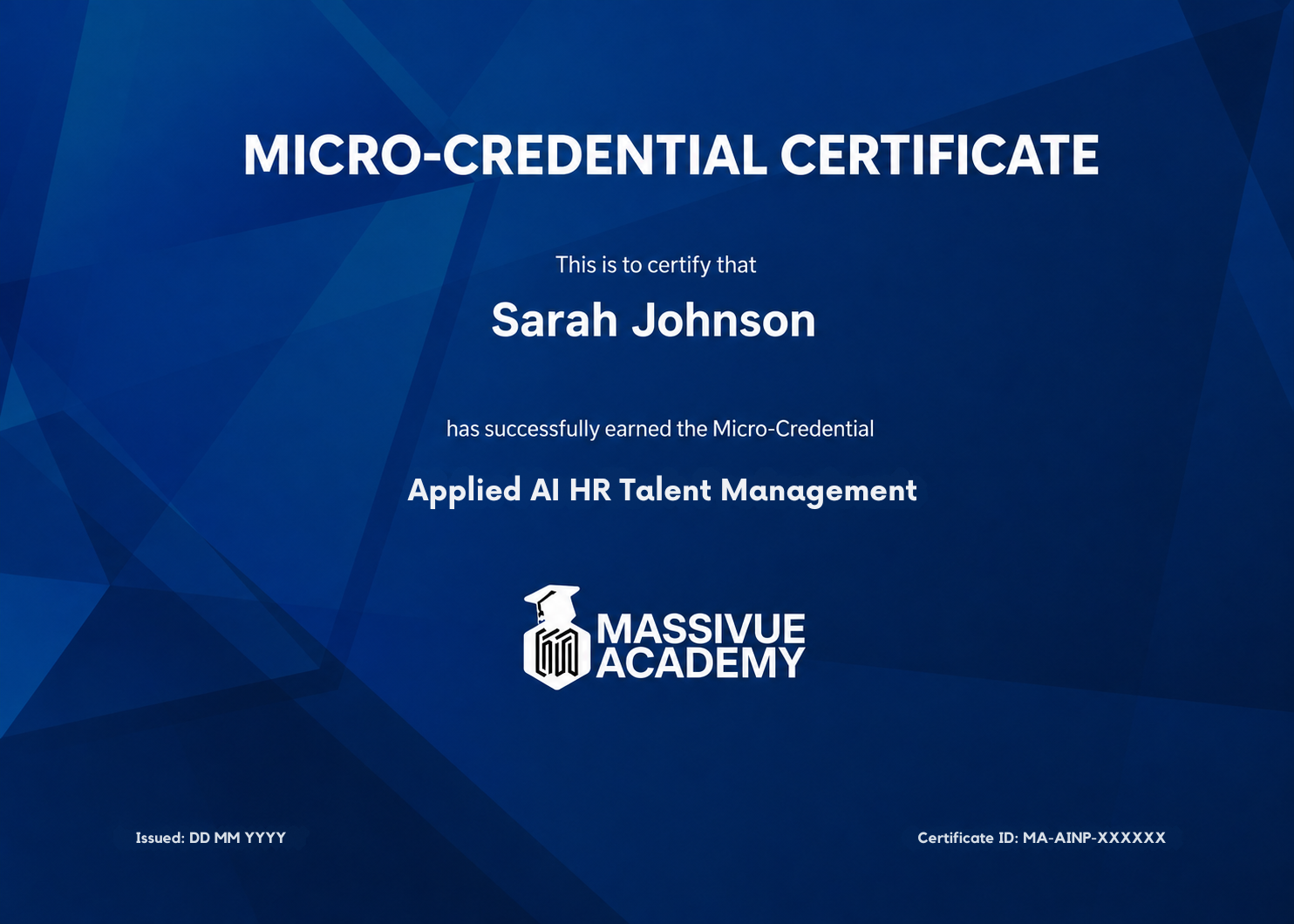
- Publicly verifiable via a unique credential link
- One-click add to your LinkedIn profile
- Verified digital credential, CPD recognition in progress
Complete all 3 to earn Certified AI HR Specialist.
Self-paced microcredentials, about 4 hours 30 min of learning in total. Each one stands alone; together they earn the full certification.
Built for the people accountable for the decision
Prerequisites: HR, Talent, People Analytics, or Workforce Strategy experience. Responsibility for hiring, performance, engagement, or workforce planning. Comfort working with data, HR systems, and organisational policies. Interest in adopting AI responsibly within people functions. No prior AI or technical background required
Everything in the credential
Bring this to your team
For teams
- Volume pricing and central billing
- Team progress reporting
- Optional tailored examples for your sector
Deliver under your brand
- Co-branded or fully white-label delivery
- Your LMS or ours
- Revenue-share partnership options
Questions, answered honestly
If an AI system's output influences a decision about someone's employment, in the EU it is likely to fall in the high-risk category: recruitment, screening, evaluation, promotion, termination, task allocation, and performance monitoring are all named. It applies extraterritorially, so a US company hiring in the EU is in scope. The compliance timeline has been moving, so verify the current dates with qualified counsel; the substance is not in dispute.
No. Providers and deployers have separate obligations, and the deployer's cannot be contracted away. Human oversight, transparency to affected candidates and employees, notifying workers before deployment, and incident reporting sit with the employer. If your vendor cannot evidence their side, that is your exposure, not theirs.
Not automatically. The Commission has been clear that a human in the loop is how you meet the oversight obligation, not a way to avoid the high-risk classification. And in practice, a reviewer who rubber-stamps a ranked list is providing oversight in name only.
It can be more consistent, which is not the same thing. A model trained on your hiring history will reproduce your historical preferences at scale, with the appearance of objectivity. Consistency applied to a biased pattern is worse, not better, because it removes the variance that occasionally produced a different outcome.
No. It is written for HR professionals and leaders. You will not build models. You will learn what the tools do, where they fail, what you are accountable for, and how to govern them.
It is a verified digital credential you can share and verify online. It is not an accredited or government-recognised qualification, and it is not legal advice. CPD recognition is in progress.
Yes, and it works best that way. HR, legal, and IT all have a role in HR AI governance, and a shared vocabulary is the precondition. Team access with volume pricing and central billing is available on request.
Related microcredentials
The tool is the easy purchase. Knowing what you are accountable for, and how to govern it, is the job.
Verified digital credential