
Let me ask you something: Are you using AI in your role right now?
If you’re like most business leaders I talk to, your answer is probably “Yes, but…”
Yes, but we’re not seeing the breakthrough results we expected. Yes, but it feels like we’re just adding shiny new tools to old processes. Yes, but we’re still waiting for that 10x improvement everyone talks about.
Here’s the uncomfortable truth: Most companies aren’t failing at AI because they lack the right tools. They’re failing because they’re trying to retrofit AI onto organizations that weren’t designed for it.
The Real Problem: Tactical vs. Strategic AI Thinking
During our recent webinar on building AI-native organizations, something fascinating happened. When I asked our audience of business leaders if they were using AI, everyone said yes. But when I dug deeper into how their organizations were actually implementing AI, the real story emerged.
Most were stuck in what I call “tactical AI thinking” – using ChatGPT for writing, trying a few AI agents, maybe deploying some automation tools. Don’t get me wrong, these tools are helpful. They can give you 30-40% productivity improvements, which is nothing to sneeze at.
But here’s what I’ve learned after guiding dozens of organizations through AI transformation: The companies seeing truly transformational results aren’t just using AI tools. They’re becoming AI-native from the ground up.
What Does “AI-Native” Actually Mean?
Think about it this way. Most companies today are like someone trying to upgrade their horse-drawn carriage by adding a better whip. But AI-native companies? They’re building the car from scratch.
The difference comes down to two fundamental shifts:
1. From Fixed Teams to Adaptive Structures Gone are the days of “these are my 20 people, and this is how we work.” AI-native teams are fluid – today you might work with 3 people and 2 AI agents, tomorrow it’s 5 different specialists plus an AI orchestration system. The work remains constant, but how you organize around it becomes completely flexible.
2. From Process-Driven to Flow-Based Interactions Remember all those agile ceremonies you’ve been doing? Daily standups, sprint planning, retrospectives? AI-native organizations are moving beyond rigid meeting structures to what we call “flow-based interactions” – you interact when there’s actual need, with the right mix of humans and AI systems.
The Framework That Changes Everything
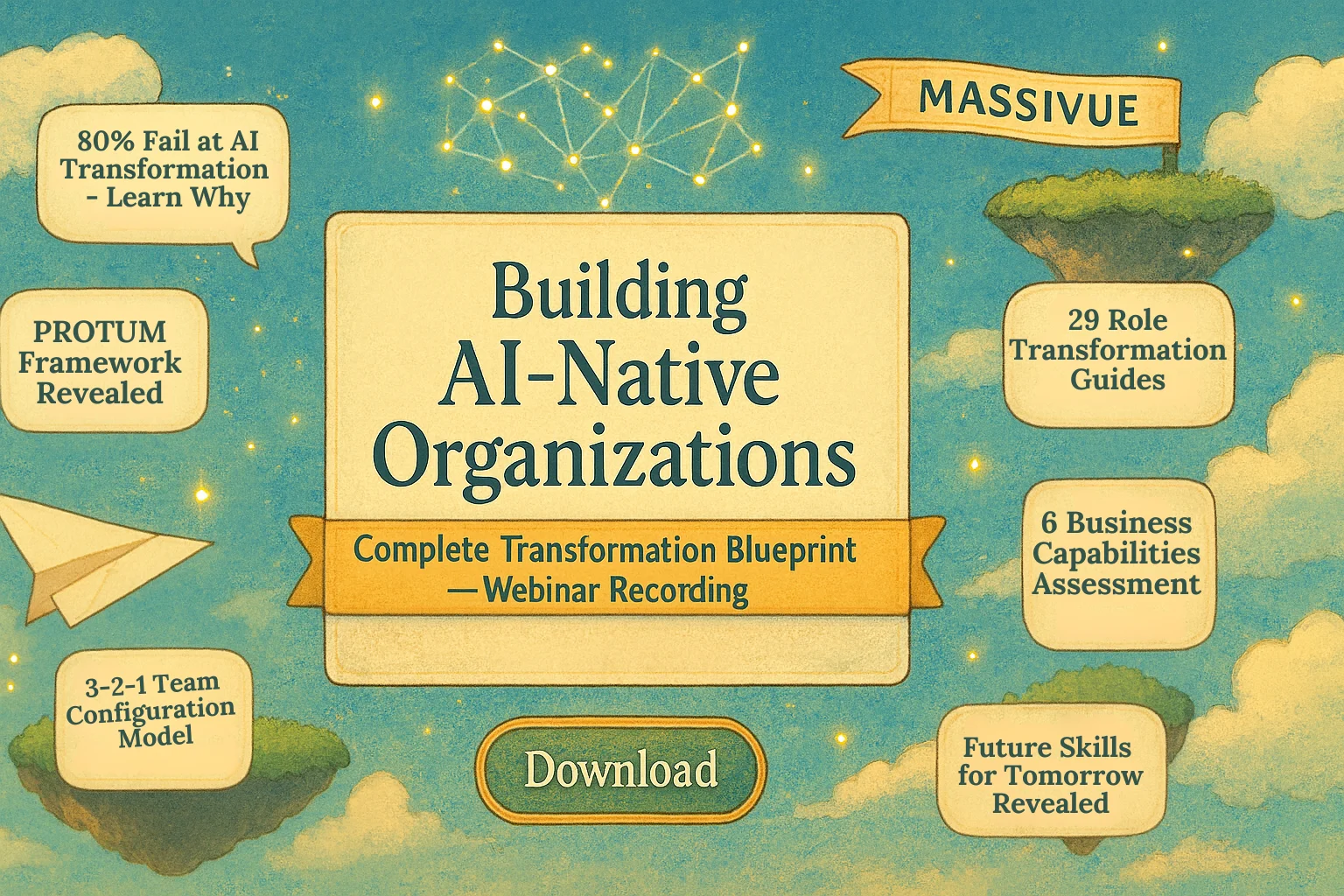
Over the past 14 months, we’ve been working with startups and established companies to develop what we call the PROTEM framework – a complete blueprint for AI-native transformation.
It’s built around six core business capabilities, arranged in what we call a “dual circle.” The inner circle is your stable core: Data Culture and Adaptive Structures. Without these, you’re just putting AI lipstick on a traditional pig.
The outer circle is where the magic happens: Impact Prioritization, Flow-Based Interactions, Responsible Intelligence, and Augmented Craft.
But here’s what makes this different from every other framework you’ve seen: It’s not just about technology or processes. It’s about fundamentally rethinking how humans and AI work together.
The New Team Structure That Actually Works
Let me give you a concrete example. In our AI-native model, teams operate with what we call a “3-2-1 configuration”:
- 3 core roles: Value Lead (think evolved product manager), AI Orchestration Lead (the person who makes human-AI workflows sing), and AI Quality Engineer (your bias and ethics guardian)
- 2 flow events: Weekly Flow Pulse for metrics and planning, and bi-weekly Quality & Learning Loop for continuous improvement
- 1 AI integration: Every team needs at least one AI touchpoint, whether it’s development tools for tech teams or domain-specific AI for operations
Notice what’s missing? Daily standups. Sprint planning. Retrospectives. Those rigid ceremonies that eat up 20% of your week while AI could be handling the coordination.
Team structure only holds if someone above it can arbitrate between teams and fund the shared layer. For the executive side of that question, see Do You Need a Chief AI Officer? and the three powers that decide whether the role changes anything.
What About Your Role?
I know what you’re thinking: “This sounds great, Sandeep, but what happens to my current role?”
Here’s the reality: AI won’t replace roles, but roles that don’t evolve with AI will become irrelevant.
Take project managers. Traditionally, they spent most of their time on progress reporting, basic risk management, and task scheduling. AI tools can handle all of that now. But the project managers who are thriving? They’ve evolved into strategic decision-makers, complex problem-solvers, and human-AI workflow orchestrators.
The same pattern applies across every role. The question isn’t whether your role will change – it’s whether you’ll lead that change or let it happen to you.
The Path Forward
Look, I get it. This can feel overwhelming. You’re already juggling a dozen priorities, and now I’m talking about fundamental organizational transformation.
But here’s what I’ve learned from working with over 30 enterprises on this journey: The companies that start this transformation now will have an insurmountable advantage over those who wait.
We’re not just talking about better productivity or cost savings (though you’ll get those). We’re talking about the ability to adapt, innovate, and compete in a world where AI capabilities are advancing every single day.
Ready to Go Deeper?
Everything I’ve shared today barely scratches the surface of what it takes to build a truly AI-native organization. During our recent webinar, we dove deep into:
- The complete PROTEM framework and how to implement it at team, department, and enterprise levels
- Real examples of how roles are evolving (with specific transition paths for 29 different positions)
- The assessment tools that show you exactly where your organization stands today
- Common pitfalls that derail 80% of AI transformation efforts
- Live Q&A addressing the specific challenges our audience faces
If you’re serious about moving beyond tactical AI use to true AI-native transformation, you need to see the full picture.
Download the complete webinar recording here: https://academy.massivue.com/products/digital_downloads/ai-transformation-guide
Get the full 60-minute deep dive, including the frameworks, tools, and strategies that we couldn’t fit into this blog post.
The recording includes detailed walkthroughs of our assessment tools, role transformation guides, and implementation roadmaps that you can start using immediately. + get an AI Toolkit for free.
Because here’s the thing: In 18 months, there will be two types of companies – those that figured out how to become AI-native, and those that are still trying to figure out why their AI tools aren’t delivering breakthrough results.
Which one will you be?